First 87Sr/86Sr isotope data for the extinct sloth Lestodon armatus: insights into the spatial ecology of South American Late Pleistocene megafauna
Abstract
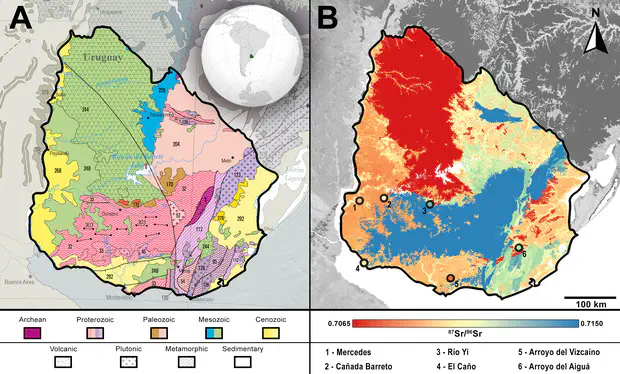
Understanding the role of megamammals in shaping terrestrial ecosystems and landscapes during the South American Late Pleistocene is crucial for estimating the impacts of extinctions on current ecological dynamics. Here, we aimed to investigate the mobility patterns and landscape use of the extinct giant ground sloth Lestodon armatus, a member of South America’s megafauna, where the Pleistocene extinction was the hardest. We report, to our knowledge, the first strontium isotope ratio (87Sr/86Sr) analysis for L. armatus, acquired from bone and dentin samples across six Uruguayan localities, including six individuals and serial sampling of a tooth from one of the sites. Our results show a highly localized 87Sr/86Sr signature for L. armatus in the study area, suggesting limited movement within a defined home range consistent with their body mass. These results rule out the existence of extensive seasonal migrations in this species. Finally, we complemented our isotopic results with a connectivity analysis to explore landscape connectivity in southern Uruguay during the Late Pleistocene. The results provide a baseline for studying the spatial ecology of megamammal communities in the region and expand the knowledge on how the extinction of large herbivores might have influenced landscape connectivity in South America during and after the Late Pleistocene.